Everyone assumes hospitals now run on AI, that scans get read by algorithms, diagnoses get made by machines, and doctors just sign off. The 2026 research tells a different, more interesting story. Here’s what AI in diagnosis, imaging, and patient care actually looks like right now, myths included.
The Myth of Healthcare Dependence on AI
Here’s the myth: that modern medicine has quietly become dependent on artificial intelligence, that scans get read by algorithms, diagnoses get flagged by machines, and clinicians have become supervisors rather than decision-makers. It’s an easy story to believe, given how much AI-in-healthcare news comes out every week. It’s also, mostly, wrong.
What the 2026 research actually shows is narrower and more interesting than “dependence.” AI is deeply embedded in specific tasks, reading certain scans, flagging certain risk patterns, drafting certain reports, but the moment you look closely at any one of those tasks, you find a clinician still making the final call, and often a study showing why that human judgment still matters. The real story isn’t AI replacing medicine. It’s AI applications in healthcare reshaping specific moments in diagnosis, imaging, and patient care, while leaving the accountability, and a lot of the actual decision-making, exactly where it was.
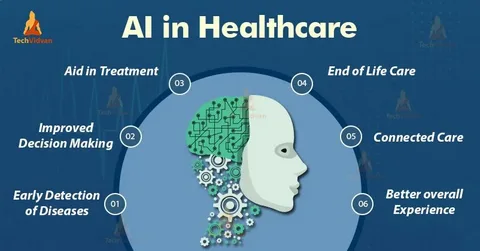
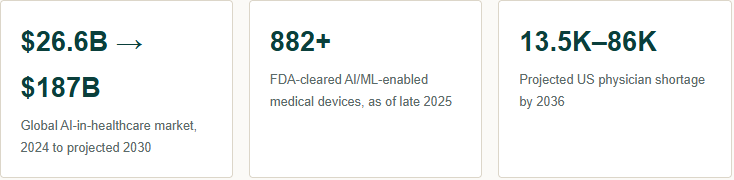
This guide walks through where that’s true, where the myth gets closer to reality than you’d expect, and where the evidence is still genuinely mixed. The scale of investment in the field is real, even if “dependence” overstates it: the global AI-in-healthcare market was valued at roughly $26.6 billion in 2024, and forecasts put it near $187 billion by 2030, a compound annual growth rate of around 38.5%. That kind of money moves toward specific, provable use cases, not vague dependence. Hospitals, insurers, and health systems are under real pressure, climbing chronic disease rates, exploding data volumes, too few clinicians to review it all by hand, and AI is being pulled in to solve particular bottlenecks, not to take over medicine wholesale.
Quick stats:
- $26.6B → $187B: Global AI-in-healthcare market, 2024 to projected 2030
- 882+: FDA-cleared AI/ML-enabled medical devices, as of late 2025
- 13,500 to 86,000: Projected US physician shortage by 2036
What’s different about 2026 specifically is the sheer density of activity in a single month. In the space of a few weeks, researchers presented new cardiac imaging findings at a major cardiology conference, a health system deployed a new AI model that can read a chest CT and write the narrative report itself, the FDA cleared a platform that unifies imaging, records, and AI in one interface, and a well-cited study quietly complicated the popular narrative that AI always makes mammography better. That’s the environment this guide is written for: not a hypothetical future, but a technology already inside hospitals, with real wins, real limitations, and real open questions about who’s accountable when it gets something wrong.
This guide walks through where AI is actually being used in healthcare today, diagnosis, imaging, and day-to-day patient care, what the research says about how well it works, and where the field is headed through the rest of the decade.
AI in Diagnosis: Where It’s Making the Biggest Impact
Diagnosis is where AI’s strengths, pattern recognition across huge datasets, tirelessness, and consistency, line up most naturally with a real clinical need. Physicians are, by necessity, generalists who see a limited number of cases in any one specialty over a career. A well-trained model can effectively “see” millions of cases, and increasingly, that shows up in results.
Pattern recognition and case prioritization
Across radiology, pathology, oncology, and cardiology, AI is shifting from a passive, after-the-fact support tool to something closer to an active diagnostic partner. In clinical labs, models are now used to flag which cases need urgent review, effectively triaging a pathologist’s or radiologist’s workload so the most time-sensitive cases don’t sit in a queue behind routine ones.
A striking example: diagnosing from a 10-second EKG
One of the more remarkable recent examples comes from Michigan Medicine, where researchers developed an AI model capable of diagnosing coronary microvascular dysfunction, a condition that standard cardiac tests often miss entirely, using nothing more than a 10-second EKG strip. This is the kind of result that captures what makes AI diagnosis genuinely useful: it’s not replacing a test, it’s extracting a diagnosis that wasn’t previously extractable at all from data clinicians were already collecting.
Why this matters: Coronary microvascular dysfunction is notoriously hard to catch with conventional testing, and it disproportionately affects patients, often women, who get sent home with a clean bill of heart health despite real underlying disease. A tool that surfaces it from a routine EKG could close a genuine diagnostic gap, not just speed up an existing one.
Point-of-care AI and access
Diagnostic AI isn’t only a hospital story. Point-of-care devices, compact tools that bring diagnostic capability to clinics, rural facilities, and underserved regions, are expanding access to diagnostic quality that used to require a specialist and a major medical center. This is arguably where AI’s impact on global health equity will be most visible over the next few years.
Regulatory momentum
The FDA has now cleared more than 882 AI/ML-enabled medical devices, with radiology tools making up the largest share of approvals. That number alone tells you two things: the pace of innovation is real, and the regulatory system has been working overtime to keep up with it. It also sets up one of the central tensions in this guide, a growing gap between how many tools get approved and how many actually get adopted in a way that changes outcomes. We’ll come back to that in the challenges section.
AI in Medical Imaging: CT, MRI, Ultrasound, and Beyond
Imaging is the single area where AI in healthcare has the deepest track record, simply because images are exactly the kind of high-volume, pattern-rich data that machine learning was built to handle. The last month alone produced several concrete examples of where this is heading.
Cardiac imaging: rethinking your “zero” report
Coronary artery calcium (CAC) scoring has long been used as a quick, reassuring signal: a score of zero has typically meant low risk. New research is complicating that. Advanced imaging using photon-counting CT, combined with AI detection of subtle calcification, is prompting a reevaluation of what a “zero” score actually means. Related work presented at the Society of Cardiovascular Computed Tomography conference showed that coronary inflammation, a factor traditional calcium scoring doesn’t capture, can identify meaningfully elevated cardiovascular risk even in patients whose calcium scores read as zero or low.
This matters beyond cardiology circles. It’s a clean example of AI not just automating an existing test, but revealing that the test itself was incomplete.
Artificial Intelligence that writes the report
A newer category of imaging AI is moving past detection and into interpretation. One recent model, built to analyze 3D chest CT volumes, generates full narrative descriptions of findings across the pulmonary, upper abdominal, cardiac, mediastinal, and soft tissue regions, essentially drafting the kind of structured report a radiologist would otherwise write from scratch. Tools like this don’t replace the radiologist’s judgment, but they meaningfully cut the time between scan and report, which matters enormously in time-sensitive cases like stroke or trauma.
Combining modalities of Cancer imaging
Single-scan analysis is increasingly being supplemented by models that combine multiple imaging types. One recent model combined MRI and ultrasound findings to predict microvascular invasion in hepatocellular carcinoma (liver cancer) with a 93% AUC, a strong result that could help clinicians decide on treatment aggressiveness before surgery rather than after.
Redefining workflows and governance in neuroradiology
Beyond any single tool, there’s a growing and important conversation about how AI actually gets integrated into daily radiology workflows, particularly in neuroradiology and stroke imaging, where speed is critical. Radiologists working directly with these tools have flagged two recurring concerns worth taking seriously: automation bias (the tendency to defer to an AI’s judgment even when a clinician’s own read would have caught something different) and the need for real governance, clear rules, audit trails, and measurable outcomes, rather than ad hoc adoption of whatever tool seems promising.
The Mammography Debate: AI’s Most Important Reality Check
If there’s one story from the past month that every healthcare-AI writer should understand deeply, it’s this one, because it resists the easy, one-sided narrative that AI coverage often falls into.
The Win: New research found that when general radiologists, not breast-imaging specialists, used adjunctive AI to assess mammograms, their cancer detection rate rose significantly, reaching a level comparable to that of dedicated breast imaging specialists. That’s a meaningful result: it suggests AI can help narrow the gap between generalist and specialist performance, which matters enormously in regions without easy access to subspecialists.
The Caution: A separate, earlier study looked specifically at cases where the AI produced a false negative, telling a radiologist a scan was likely clear when it wasn’t. In those cases, radiologists working without AI assistance had a 32% higher sensitivity rate than radiologists who had used AI. In other words, a confident wrong answer from the AI appeared to pull some radiologists toward missing something they might otherwise have caught.
Put those two findings side by side and you get the most honest picture available of where AI-assisted imaging actually stands: it can raise the floor for generalists, and it can also introduce a new kind of error mode, one where an AI’s false confidence quietly overrides a clinician’s own instinct. Neither finding cancels the other out. Both are true, from different studies, in the same few months.
For a health-focused blog, this is a genuinely valuable, differentiated angle: most coverage of “AI in mammography” picks one story and runs with it. A post that holds both findings in tension, and draws the honest conclusion that AI works best as a second opinion a clinician can override, not an authority a clinician defers to, will read as more credible than most of what’s currently published on the topic.
AI in Patient Care Beyond Diagnosis
Diagnosis and imaging get most of the headlines, but a large share of AI’s actual day-to-day impact in healthcare shows up in less dramatic, more operational places.
Clinical decision support and clinician time
Philips’ Future Health Index 2026 report, based on surveys of more than 2,000 healthcare professionals and over 20,000 patients across 10 countries, found that AI is expanding clinical capacity, saving time, strengthening decision-making, and, notably, improving work-life balance for many clinicians. That last point matters: a lot of the AI-in-healthcare conversation focuses on patients, but clinician burnout is itself a patient-safety issue, and tools that give time back to overstretched staff are addressing that indirectly.
Operational efficiency and workflow automation
Away from the exam room, AI is increasingly handling the administrative load that eats into clinical time: scheduling, documentation, prior authorization support, and coding. This is less visible than a diagnostic breakthrough, but it’s arguably where AI delivers its most consistent, low-risk return on investment today.
Personalized medicine and genomics
AI’s ability to process genetic and molecular data alongside clinical history is accelerating personalized treatment planning, matching patients to therapies based on their specific genetic and disease profile rather than population averages. This overlaps closely with AI’s growing role in drug discovery, covered below.
Platform consolidation
A quieter but important trend: the tools themselves are consolidating. CliniComp recently received FDA 510(k) clearance for a PACS viewer that unifies diagnostic imaging, enterprise electronic health records, and native AI into a single platform, rather than clinicians toggling between three or four disconnected systems. Separately, NVIDIA and GE HealthCare are collaborating on a medical device simulation platform to advance autonomous diagnostic imaging systems, using pretrained models and physics-based simulations of sensors and anatomy to test imaging systems virtually before deployment.
Both point to the same underlying shift: healthcare AI is moving from “an extra tool bolted onto existing systems” to “a native layer built into the infrastructure itself.”
Agentic AI in Healthcare: The Next Frontier, and Its Risks
The next wave of healthcare AI isn’t just about analyzing a single scan or flagging a single lab value, it’s about systems that can independently plan and execute multi-step tasks without continuous human direction. This is what’s being called agentic AI, and in a clinical context it means something specific: a system capable of reviewing a patient’s charts, labs, imaging, and medication lists together, identifying concerning trends across all of them, and drafting a suggested care plan on its own.
The appeal is obvious. No single clinician can hold every data point on every patient in working memory at once; an agentic system, in principle, can. The risk is just as significant. Because these systems act autonomously across multiple steps, a single mistake in diagnosis or treatment recommendation doesn’t stay contained, it can trigger a chain of incorrect downstream actions before a human ever reviews it. And when something does go wrong, accountability becomes genuinely unclear: is it the model developer, the hospital that deployed it, or the clinician who signed off on its recommendation?
The open question: Agentic AI in healthcare is advancing faster than the governance frameworks meant to oversee it. Expect this to be one of the defining regulatory conversations in medicine over the next two to three years, and a rich, evergreen topic for ongoing coverage on this blog.
Adjacent Applications Worth Knowing
A few related fields deserve a mention here, each substantial enough to support its own dedicated post on this blog:
- AI in drug design and discovery, using machine learning to predict molecular behavior, screen compounds, and shorten the years-long process of bringing a new drug to trial.
- AI in molecular simulation and dynamics, modeling how molecules interact at a physical level, accelerating research that used to depend entirely on slow, expensive lab experimentation.
- Leading AI healthcare companies, the vendors, from established health-tech players to newer AI-native entrants, actually building and deploying these tools inside hospitals and health systems today.
Related reading on this blog: AI in Drug Design and Discovery · AI in Molecular Simulation and Dynamics · Top AI Healthcare Companies · Agentic AI in Healthcare: Promise and Accountability Risks
Challenges and Limitations Faced with AI Integration
No honest guide to AI in healthcare can stop at the wins. A few limitations come up repeatedly across the research, and they’re worth naming plainly.
Automation bias
As the mammography research showed, clinicians can defer too readily to an AI’s output, even when their own judgment might have caught an error. This isn’t a flaw unique to any one tool, it’s a known human-factors risk whenever a confident-sounding system sits between a clinician and a decision.
Underreported harm
Patient harm remains one of the leading causes of morbidity and mortality worldwide, and healthcare systems are estimated to capture only about half of the harm events that actually occur, acting on fewer still. That reporting gap makes it genuinely difficult to know how AI tools are performing in the real world once they leave a controlled study, good outcomes and bad ones alike can go undocumented.
The approval-to-adoption gap
More than 882 AI/ML-enabled devices have FDA clearance, but clearance is not the same as widespread, effective use. The tools most likely to have a lasting impact are the ones built by developers who genuinely listen to what clinicians need, not simply the ones that are easiest to build or fastest to market. A crowded field of approved tools doesn’t guarantee a crowded field of tools that actually change outcomes.
Systemic pressure
It’s also worth noting that AI is being adopted against a backdrop of real strain on the healthcare system more broadly, including significant funding reductions to Medicaid and Medicare and the discontinuation of research grants to hospitals and medical schools. AI adoption isn’t happening in a vacuum of unlimited resources; in many cases it’s being asked to help absorb pressure created elsewhere in the system.
The Future of AI in Healthcare, 2026 to 2030
A few threads seem likely to define the next few years as:
- Continued market growth toward that projected $187 billion figure by 2030, driven largely by diagnostics, imaging, genomics, and personalized medicine.
- A shift from passive to active tools, AI moving from flagging things for a human to review, toward actively prioritizing, drafting, and in some cases recommending next steps.
- Governance catching up to agentic AI, as hospitals and regulators work out accountability frameworks for systems that act across multiple steps without constant human sign-off.
- Consolidation of tooling, as imaging, records, and AI increasingly live in unified platforms rather than a patchwork of separate systems.
- A widening gap between hype and adoption, with the tools that survive being the ones built around real clinical workflows rather than technical novelty.
The physician shortage, projected at somewhere between 13,500 and 86,000 doctors by 2036, gives all of this a practical urgency. AI in healthcare isn’t primarily a story about efficiency for its own sake; it’s increasingly a story about how a strained system keeps functioning at all.
Conclusion: So Is the Myth True?
Not really, and that’s the point. Healthcare in 2026 isn’t dependent on AI in the way the myth suggests. It’s genuinely useful, genuinely fast-moving, and genuinely imperfect, often all three at once, in specific tasks a clinician still oversees. AI can help a general radiologist read a mammogram like a specialist, and it can also lead a different radiologist to miss something they’d have caught on their own. It can diagnose a hidden heart condition from a 10-second EKG, and it can also raise real, unresolved questions about who’s accountable when an autonomous system gets something wrong. None of that is dependence. It’s assistance, unevenly distributed, still supervised.
The throughline across every example in this guide is the same: AI works best in healthcare as a second opinion a clinician can weigh, question, and override, not as an authority that replaces clinical judgment, and certainly not as something medicine has become dependent on. The technology is advancing quickly enough that this guide will need updating within months, not years. That’s exactly why it’s worth returning to, and why the myth is worth re-checking every time.
People Like to Ask:
Is AI diagnosis more accurate than doctors? It depends on the task and the setting. In some studies, AI-assisted general radiologists matched specialist-level cancer detection rates. In others, AI-assisted clinicians performed worse than unassisted ones on specific error types, such as false negatives in mammography. The most accurate framing is that AI can improve average performance across a group of clinicians while also introducing new failure modes, it isn’t simply “better” or “worse” than a doctor in isolation.
What is agentic AI in healthcare? Agentic AI refers to systems that can independently plan and carry out multi-step tasks, for example, reviewing a patient’s charts, labs, and imaging together, spotting concerning trends, and drafting a suggested care plan, without needing continuous human direction at each step.
Is AI-assisted mammography safe? Current evidence is mixed rather than uniformly reassuring. AI assistance has been shown to raise cancer detection rates among general radiologists to specialist-comparable levels, but separate research found that in cases where AI produced a false negative, unassisted radiologists caught more true positives than AI-assisted ones did. The practical takeaway is that AI should support, not replace, a radiologist’s independent judgment.
Which companies lead AI healthcare innovation? The field spans established health-tech and imaging companies, major cloud and chip providers partnering directly with health systems, and a growing number of AI-native startups focused on specific diagnostic niches. See our companion post on leading AI healthcare companies for a detailed breakdown.
How big is the AI healthcare market? The global AI-in-healthcare market was valued at approximately $26.6 billion in 2024 and is projected to grow to nearly $187 billion by 2030, at a compound annual growth rate of roughly 38.5%.
This guide is updated regularly to reflect new research and industry developments. Last major update: July 2026.

