
Who are Colette Kress and Harvey C. Jones? Inside the duo now running Nvidia ahead of a high-stakes earnings test
Interim CEO Colette Kress convened Nvidia's executive leadership team at its Santa Clara headquarters Friday as she and newly appointed board chair Harvey C. Jones took command of the $3.8 trillion chipmaker following co-founder Jensen Huang's sudden resignation.
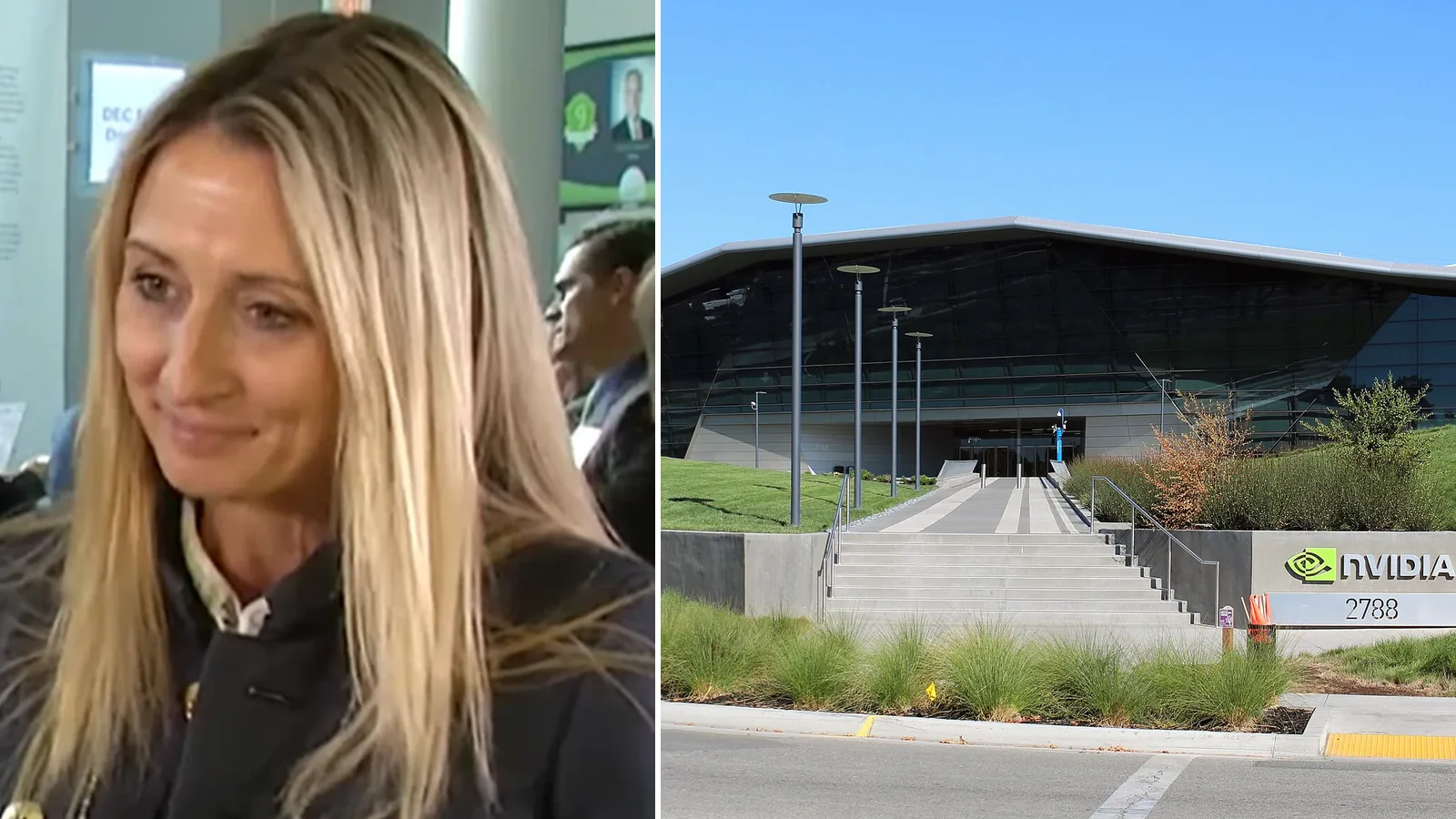
For 33 years, Nvidia had only one chief executive and never once appointed a chairman of the board. In less than 24 hours, both traditions ended at the center of the global artificial intelligence economy.
Following co-founder Jensen Huang’s abrupt resignation as president, chief executive, and board director on Thursday, executive vice president and chief financial officer Colette Kress stepped in as interim CEO while longtime director Harvey C. Jones became the first Chair of the Board in Nvidia’s history. On Friday, Kress summoned Nvidia’s top executive leadership team to the company’s Endeavor headquarters in Santa Clara, California, moving swiftly to steady operations as semiconductor shares slid across Wall Street and lawmakers prepared to question Huang on Capitol Hill before Thanksgiving.
With Nvidia scheduled to report fiscal third-quarter 2027 financial results on Tuesday, November 17, global investors, cloud hyperscalers, and enterprise buyers are scrutinizing the two veteran executives suddenly holding the reins of the world’s most closely watched chipmaker.
Colette Kress: The 13-year finance architect behind Nvidia’s $4 trillion ascent
To institutional investors on Wall Street, the 59-year-old Kress has long been the second most recognizable voice at Nvidia. Hired as executive vice president and chief financial officer in September 2013, Kress arrived when Nvidia was still valued near $9 billion and generated roughly $4 billion in annual revenue primarily from PC gaming graphics cards.
Over the next 13 years, Kress oversaw the capital allocation, supply-chain commitments, and balance-sheet expansion that powered Nvidia’s transformation into the foundational hardware supplier of generative artificial intelligence, briefly lifting its market capitalization past $5 trillion before this week’s governance shock. Under the board’s transition plan, she will hold both the interim CEO and CFO titles while an executive search committee evaluates internal and external candidates for a permanent chief executive.
Before joining Nvidia, Kress built nearly two decades of operational finance experience inside three of America’s largest enterprise hardware and software companies:
- Before moving to Santa Clara, she served for three years as senior vice president and chief financial officer of Cisco’s Business Technology and Operations Finance organization, overseeing engineering, manufacturing, and supply-chain budgets across the networking giant.
- Prior to Cisco, she spent 13 years at Microsoft, including four years as chief financial officer of the company’s Server and Tools division—the exact enterprise infrastructure unit that laid the groundwork for Microsoft Azure.
- Earlier in her career, she held corporate finance and planning positions at semiconductor manufacturer Texas Instruments after earning a bachelor’s degree in finance from the University of Arizona and an MBA from Southern Methodist University.
In an internal email sent to Nvidia’s global workforce after Thursday’s announcement and reviewed by CNBC, Kress told employees she “believed deeply” in Nvidia’s future and pledged to build on the accelerated-computing roadmap already underway across Blackwell and next-generation Rubin data-center systems. Analysts have noted that Kress brings disciplined financial guardrails to customer financing deals and sovereign cloud commitments at a moment when Wall Street is questioning long-term capital returns across the AI sector.
Harvey C. Jones: The 1993 founding-era director named Nvidia’s first board chair
While Kress manages day-to-day corporate strategy and customer deliveries, governance oversight and the permanent CEO search now rest with Harvey C. Jones—an electronic design automation pioneer whose ties to Nvidia stretch back to the company’s earliest months.
Jones joined Nvidia’s board of directors in 1993, the same year Jensen Huang, Chris Malachowsky, and Curtis Priem founded the graphics chipmaker in Sunnyvale. Because Huang held both the president and CEO roles without a separate board chair for more than three decades, Thursday’s board resolution formally created the chairmanship for the first time to separate board oversight from executive management during the leadership transition.
Across four decades in Silicon Valley, Jones built and backed several foundational chip-design software companies:
- During the 1980s, Jones co-founded Daisy Systems Corporation, one of the earliest computer-aided engineering firms that automated microchip circuit design, rising to president and chief executive officer.
- He subsequently spent nearly a decade leading Synopsys Inc. as chief executive officer and executive chairman, scaling the Mountain View software developer into one of the semiconductor industry’s essential electronic design automation suppliers—tools Nvidia’s own silicon engineers rely on to design GPUs.
- Since the late 1990s, he has served as managing partner of private investment firm Square Wave Ventures while advising Nvidia’s board through the dot-com crash, the rise of CUDA parallel computing, and the generative AI boom. Jones holds a bachelor’s degree in mathematics and computer sciences from Georgetown University and a master’s degree in management from the MIT Sloan School of Management.
In his own message to Nvidia employees Thursday, Jones praised the staff’s resilience and emphasized continuity across engineering and manufacturing schedules. “The Board has full confidence in Colette to deliver on our commitments to shareholders, customers, partners, and to each of you,” Jones wrote, adding that Nvidia expects its product roadmap and customer shipments to proceed without interruption.
The immediate test: November 17 earnings and Capitol Hill scrutiny
Kress and Jones have virtually no grace period before facing public markets. Nvidia shares slid another 3.9% during Friday trading to hover near a $3.8 trillion valuation—down roughly 14% since November 6—even as the company reaffirmed its $10 billion anchor commitment to Anthropic’s six-times-oversubscribed Nasdaq IPO.
On Tuesday afternoon, Kress will step onto Nvidia’s fiscal third-quarter earnings call—historically a showcase dominated by Huang—to field live questions from Wall Street analysts on Blackwell rack shipments, gross margins, hyperscaler orders through 2027, and whether the board favors an internal engineering lieutenant or an outside semiconductor chief for the permanent CEO seat.
At the same time, Kress and Jones must insulate Nvidia’s commercial operations from escalating political scrutiny in Washington. Following reports surrounding Huang’s personal conduct and legal representation, House Foreign Affairs Committee Chairman Brian Mast said Huang has agreed to testify under oath before Congress ahead of the Thanksgiving holiday, while Senate Banking Committee leaders have demanded answers regarding national security protocols and U.S. export-control safeguards. How convincingly Kress and Jones separate Nvidia’s day-to-day execution from its founder’s departure on Tuesday’s call will set the tone for the entire technology market heading into year-end.