Infineon projects nearly €4 billion in data center power chip sales as 2027 revenue outlook tops €20 billion
German semiconductor maker Infineon closed fiscal 2026 with a record €4.706 billion quarter and forecast roughly €20 billion in fiscal 2027 revenue as artificial intelligence server halls and grid upgrades drive power chip demand.
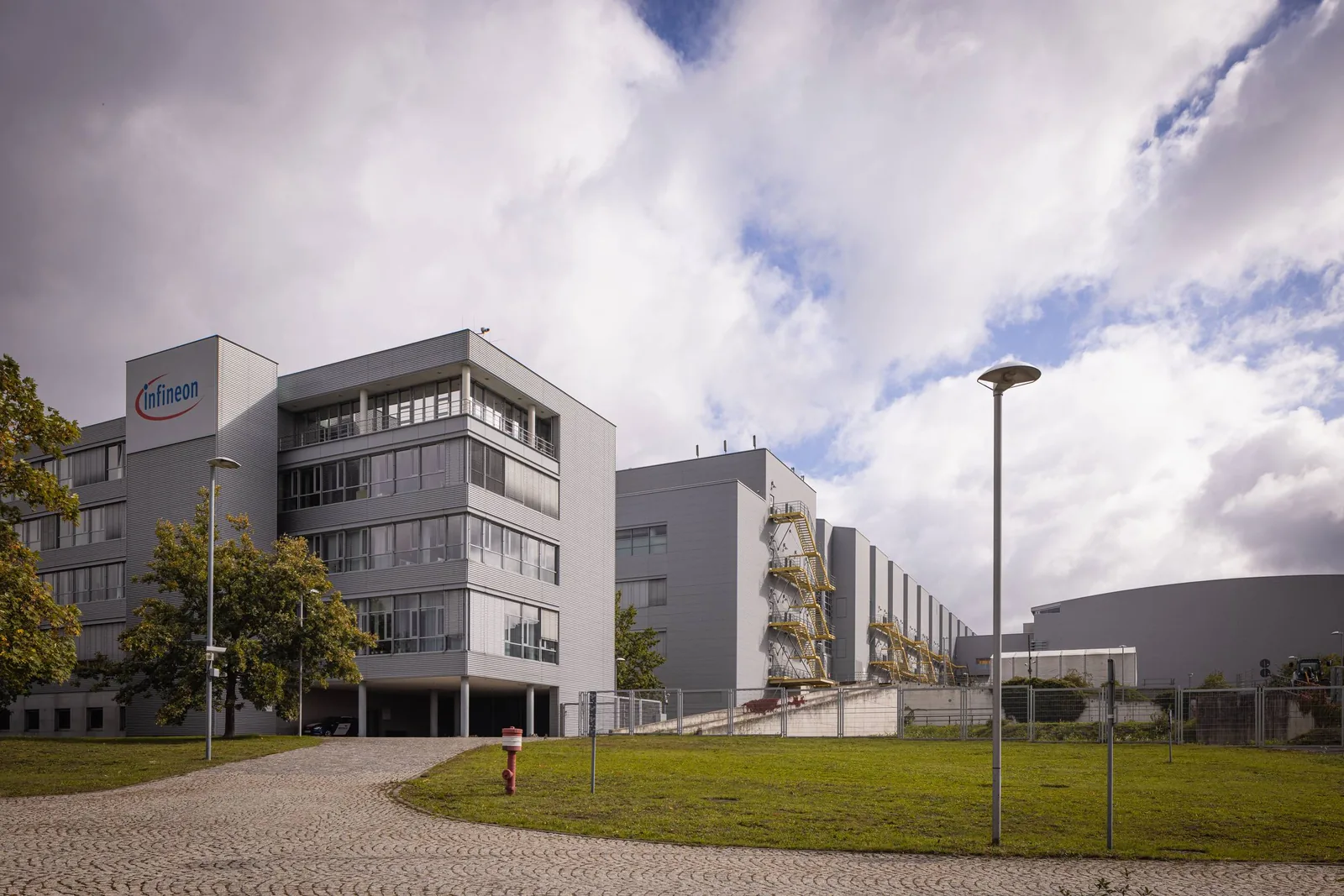
German chipmaker Infineon Technologies projected on Tuesday morning that revenue from power supply semiconductors for data centers will climb close to €4 billion in fiscal 2027, anchoring a forecast that total company revenue will rise more than 20 percent to roughly €20 billion after a record final quarter.
The guidance, issued from Neubiberg near Munich ahead of the European market open in Infineon’s fourth quarter and fiscal 2026 regulatory release, offers concrete balance sheet evidence of how artificial intelligence spending is spreading beyond training processors into electrical conversion hardware. If Infineon reaches its target, server power components alone will account for nearly one fifth of the group’s projected annual revenue.
Public debate around artificial intelligence infrastructure has centered largely on graphics processors and memory chips, yet every megawatt entering a computing campus must pass through specialized power semiconductors before reaching a processor. Those devices step utility electricity down from medium and high grid voltages to the low voltage rails required inside server racks while limiting wasted heat.
As server rack power density climbs, conversion efficiency has become an immediate financial and regulatory constraint for cloud operators and electric utilities alike. That bottleneck sits behind recent moves across the computing sector, including Anthropic’s commitments to finance dedicated power generation capacity as utilities scrutinize whether industrial load growth could push grid upgrade costs onto residential ratepayers.
Record fourth quarter closes fiscal 2026 recovery
Infineon’s fiscal year ended on September 30, 2026, and the fourth quarter figures published on Infineon’s investor financial results portal show an acceleration across most of its industrial and automotive lines. Fourth quarter revenue rose 13 percent from the preceding three months to €4.706 billion, up from €4.172 billion in the third quarter.
Profitability expanded considerably faster than sales as factory utilization improved. Infineon’s preferred operating benchmark, which it calls Segment Result, jumped 40 percent sequentially to €1.119 billion from €797 million, lifting the Segment Result Margin to 23.8 percent from 19.1 percent in the prior quarter.
Reported gross margin reached 41.8 percent in the fourth quarter, up a full percentage point from 40.8 percent, while adjusted gross margin climbed from 42.8 percent to 45.1 percent. Operating profit rose to €775 million from €594 million even after accounting for €344 million in expenses outside the operating segments across cost of goods sold, research, and administration.
Net profit for the fourth quarter reached €532 million, up 26 percent from €423 million in the third quarter, lifting diluted earnings per share from continuing operations to €0.40 and adjusted diluted earnings per share to €0.60. Across the full 2026 fiscal year, revenue grew 12 percent to €16.353 billion, Segment Result totaled €3.223 billion at a 19.7 percent margin, and adjusted earnings per share stood at €1.73.
Cash generation also strengthened despite heavy acquisition and plant spending. Fourth quarter operating cash flow from continuing operations nearly doubled sequentially to €2.171 billion from €1.114 billion, allowing Infineon to post €656 million in quarterly Free Cash Flow even after paying €564 million to complete its purchase of the sensor portfolio from ams OSRAM.
For the full 2026 fiscal year, Free Cash Flow reached €993 million and Adjusted Free Cash Flow stood at €1.925 billion. Gross cash rose to €2.137 billion at the end of September against €6.850 billion in financial debt, trimming net debt to €4.713 billion from €5.185 billion three months earlier.
Power chips lead reorganized business lines
Chief Executive Jochen Hanebeck attributed the stronger trajectory to a combination of cyclical inventory normalization and structural demand across server power supplies, electric grid modernization, electromobility, and vehicles built around centralized computing architectures. To align its reporting with those markets, Infineon reorganized its operations on July 1, 2026 into three divisions: Power Systems, Automotive, and Edge Systems.
The recovery remains uneven across those three pillars, a distinction that matters for investors and industrial customers reading the headline growth rate. In the fourth quarter, legacy reporting showed strong gains in Automotive, Green Industrial Power, and Power and Sensor Systems, whereas Connected Secure Systems declined as consumer and general microcontroller demand lagged behind heavy infrastructure spending.
That split carries directly into the opening quarter of fiscal 2027, which runs from October through December and normally brings a seasonal dip in semiconductor shipments. Assuming an exchange rate of 1.15 US dollars per euro, Infineon expects first quarter revenue of roughly €4.6 billion and a Segment Result Margin near 23 percent, with stable sales in Automotive and Power Systems offsetting a moderate decline in Edge Systems.
Over the full 2027 fiscal year, management forecasts that Power Systems will expand substantially faster than the group’s overall 20 percent growth rate as data center power revenue approaches €4 billion. Automotive revenue is projected to rise by a percentage in the mid teens as automakers add power electronics and zone controllers, while Edge Systems is forecast to grow in the low teens.
If those volume targets hold, Infineon projects that its adjusted gross margin will reach the mid to high forties percentage range in fiscal 2027 while its Segment Result Margin climbs roughly five percentage points from fiscal 2026 into the mid twenties. Those figures remain preliminary management projections rather than audited guarantees, and they depend heavily on sustained hyperscale capital budgets and currency stability near the assumed 1.15 dollar rate.
Factory spending targets new semiconductor materials
Meeting higher server and grid specifications requires manufacturing changes that go beyond adding conventional silicon capacity. Infineon plans between €3.0 billion and €3.5 billion in capital investments during fiscal 2027 across property, plant, equipment, and capitalized development, while budgeting roughly €2.2 billion in depreciation and amortization.
Three flagship frontend wafer initiatives anchor that spending plan. In Germany, Infineon is equipping and ramping production inside its fourth manufacturing building in Dresden, expanding European fabrication capacity for analog, mixed signal, and power devices.
In Kulim, Malaysia, the company is expanding silicon carbide wafer production, while in Villach, Austria, it plans to begin manufacturing gallium nitride power chips on 300 millimeter wafers. Parallel backend assembly and testing expansions are scheduled for facilities in Bangkok, Thailand, and Melaka, Malaysia.
The shift toward silicon carbide and gallium nitride alongside silicon reflects basic electrical physics rather than marketing novelty. Both compounds tolerate higher electric fields and switch current faster with lower energy loss than standard silicon, allowing engineers to shrink bulky server power shelves, electric vehicle inverters, and solar or grid transformers while cutting cooling requirements.
At the same time, scaling specialty semiconductor materials exposes European and Asian manufacturers to upstream mineral supply concentration, a vulnerability highlighted this week by China’s tightened export licensing controls on critical minerals. Scaling 300 millimeter gallium nitride wafers is intended to drive down per chip manufacturing costs by fitting far more dies onto each circular wafer, though yield ramps on larger wafer diameters carry execution risk during initial production phases.
Shareholder returns and pending memory sale
Alongside its factory budget, Infineon’s Management Board announced plans to propose a dividend of €0.38 per share at the company’s Annual General Meeting scheduled for February 25, 2027, up €0.03 from the prior year. Across roughly 1.301 billion dividend eligible shares excluding treasury holdings, the payout would distribute approximately €494 million while leaving baseline fiscal 2027 Free Cash Flow near €1.8 billion and Adjusted Free Cash Flow near €2.2 billion.
One notable transaction remains outside Tuesday’s guidance numbers. Infineon noted that its fiscal 2027 outlook excludes its previously announced agreement to sell its NOR Flash and ferroelectric memory business to Taiwan’s Winbond.
Should regulators clear that divestiture in the second half of calendar year 2027, Infineon estimates that pretax cash proceeds could lift fiscal 2027 Free Cash Flow by up to €1 billion without materially altering operating revenue or segment margins. Investors will get their next checkpoint on whether server power orders and automotive shipments are tracking those targets when Infineon reports first quarter results, preliminarily scheduled for February 3, 2027.