
SpaceX Catches Starship's Upper Stage With Tower Arms for the First Time After Orbital Flight
SpaceX caught the upper stage of its Starship megarocket with the 'chopsticks' arms of its Starbase launch tower on Saturday, the first time a returning Ship has been recovered this way. The milestone came roughly 22 hours after Flight 15 lifted off, and a day after the Super Heavy booster's own catch attempt ended in an explosion over the Gulf of Mexico.
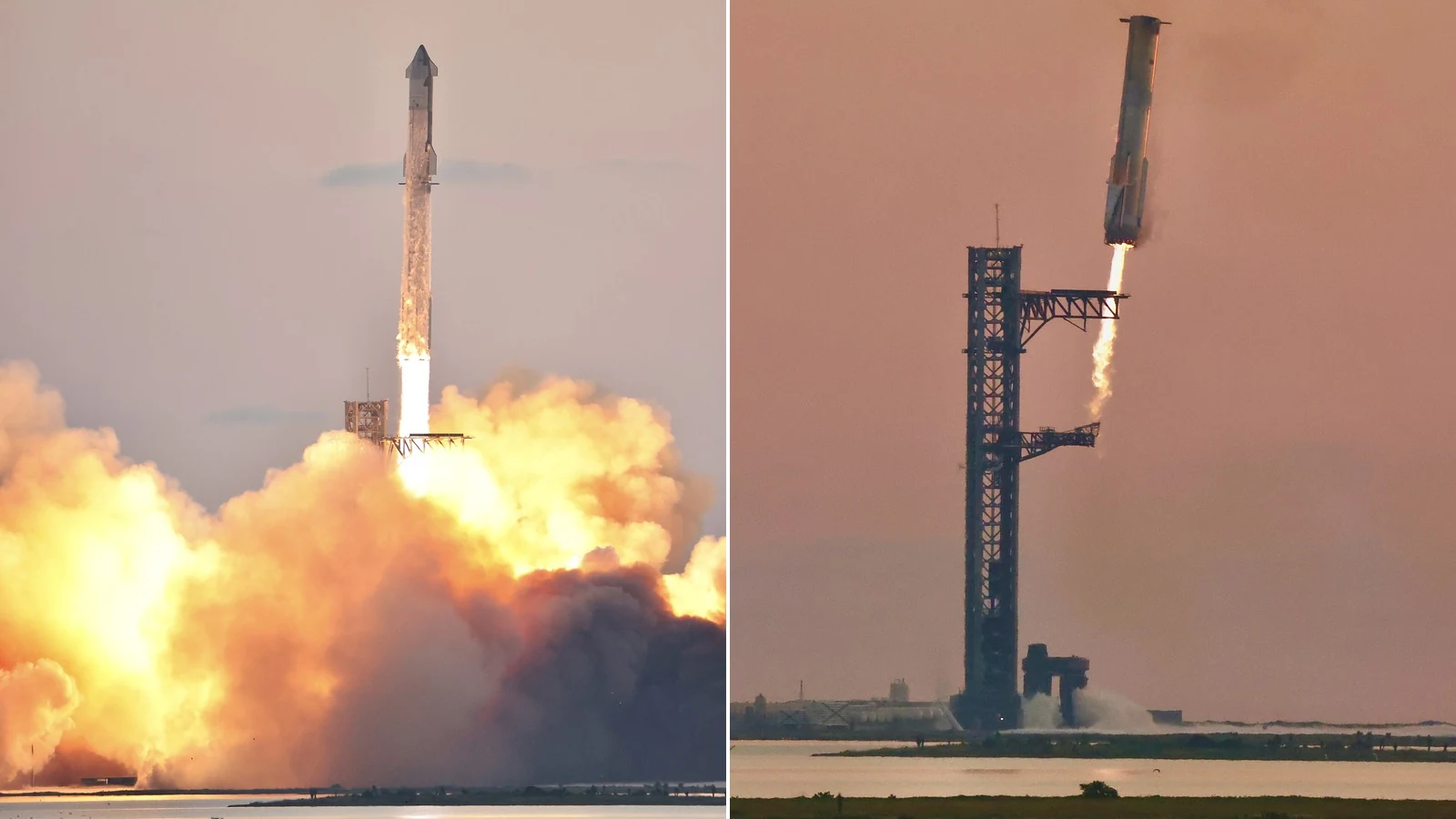
SpaceX has caught the upper stage of its Starship rocket with its launch tower for the first time. On Saturday afternoon in South Texas, the tower’s giant mechanical arms closed around the returning spacecraft, known as Ship 42, after almost a full day in orbit.
The catch came at Starbase, near the US-Mexico border, at about 21:20 GMT on November 14. The BBC called it a “picture perfect” success. No upper stage of any rocket had been recovered this way before. The arms are nicknamed “chopsticks”, and the tower itself “Mechazilla”.
It was a sharp turnaround for Flight 15, the 15th Starship test. Just over 22 hours earlier, the mission’s Super Heavy booster had been destroyed after it abandoned its own landing attempt.
How the Ship came home
Ship 42 lifted off on top of Super Heavy from Orbital Launch Pad 2 at Starbase on Friday, November 13, at about 22:47 GMT. That was the late afternoon of Friday local time, and the early hours of Saturday in India.
The upper stage reached orbit, only the second time a Starship has done so. It then released 26 of SpaceX’s new Starlink V3 internet satellites. One Starship can carry up to 60 of them, according to the company. Its Starlink network already has more than 11,000 satellites in low Earth orbit.
The Ship spent about 22 hours in space and circled the planet roughly 14 times. Then it came back through the atmosphere, which is a much harder ride than the booster’s few minutes of flight. It had to survive the heat of re-entry from orbital speed before steering back to the tower that launched it.
On SpaceX’s broadcast, communications manager Kate Tice said every team had declared itself ready for the attempt. Coverage of the landing showed the vehicle slowing to a hover beside the tower, then easing in between the arms, which held it in place.
A day earlier: the booster explodes
Flight 15 was the first Starship test to try to recover both halves of the rocket. The first half did not go to plan.
The upgraded Super Heavy booster separated from the Ship and headed back towards Starbase for its own tower catch. During its landing burn, the attempt was called off and the booster was diverted out over the Gulf of Mexico. It burst into a fireball just above the water about six and a half minutes after liftoff.
SpaceX’s Dan Huot first put the abort down to a guidance, navigation and control (GNC) problem. On Saturday he corrected that account. He said the GNC system had actually done its job by triggering the abort, because the booster “was not in the place that it was supposed to be.” SpaceX has not yet given a full explanation for why the booster was off position.
Super Heavy boosters have been caught by the tower on earlier flights. This was the first recovery attempt with the newer, upgraded version of the booster.
Why the catch is a big deal
SpaceX wants Starship to work like an airliner: land, refuel and fly again within hours, instead of throwing away expensive hardware after every launch. Tower catches are central to that plan. Landing straight back on the launch mount removes the need for landing legs and drone ships, and puts the vehicle where it can be turned around fastest.
Until Saturday, only half of that system had been shown to work. The Ship is the harder half to recover. It carries the heat shield that takes the full force of re-entry, and it has to come back from orbit rather than from a few minutes of suborbital flight.
There is a lot riding on it. Starlink is SpaceX’s main money-maker, and the company needs a cheap, reusable Starship to launch the heavier V3 satellites in large numbers. NASA has chosen Starship as the lander for its Artemis programme, which is targeting a crewed Moon landing in 2028. Elon Musk has also long described Starship as the vehicle that will one day carry people to Mars.
The rocket matters well beyond engineering, too. SpaceX is also planning $74 billion of AI supercomputing campuses at Starbase and in Arizona. And reports say it is in advanced merger talks with Tesla. A Starship that can fly and land over and over again supports the value investors place on the company.
Disruption on the ground
The launch also caused knock-on effects far from Texas. CNBC reported that Hawaii’s Department of Transportation temporarily paused some West Coast flights on Friday because of the risk of debris from the launch.
That was separate from the nationwide FAA ground stop on Friday, which was caused by a telecommunications failure rather than the rocket. That order has since been lifted.
What comes next
There is still a lot to do before Starship lands astronauts on the Moon. NASA’s plan depends on SpaceX showing it can transfer large amounts of propellant between Starships in orbit, a technique that has never been tried at this scale. Each lunar landing will need a series of tanker flights.
The next tests are likely to focus on getting the upgraded booster back to the tower, and then on reflying recovered hardware. For now, SpaceX has something it has been working towards for years: a Starship upper stage that went to orbit, came back, and was caught by the tower it launched from.
Sources: BBC News live coverage; CNBC; Space.com live updates; India Today (November 13–14, 2026).