G7 foreign ministers meet Ukraine envoy in Paris as US mediated talks with Russia open in Abu Dhabi
Top Group of Seven diplomats are meeting Ukrainian Foreign Minister Andrii Sybiha in Paris on Tuesday even as American envoys convene Russian and Ukrainian negotiators in Abu Dhabi without European governments in the main room.
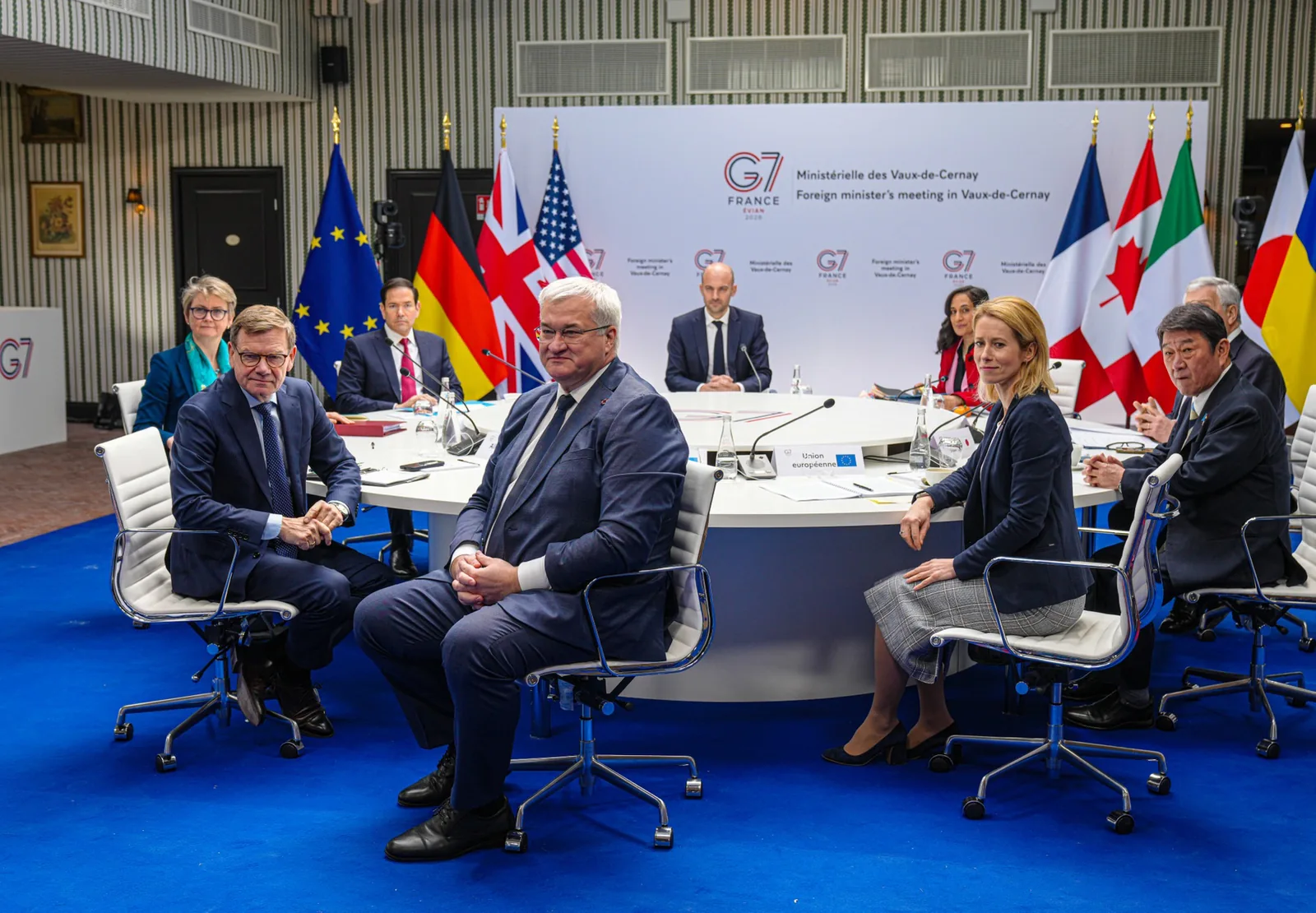
Foreign ministers from the Group of Seven democracies opened Tuesday’s sessions in Paris with Ukrainian Foreign Minister Andrii Sybiha on the same morning American presidential envoys began separate, closed door talks with Russian and Ukrainian delegations in Abu Dhabi, exposing an unresolved rift among allies over when Europe will gain a direct seat in negotiations over its own security.
Sybiha scheduled bilateral morning discussions in the French capital with US Secretary of State Marco Rubio before joining foreign ministers from France, Germany, Britain, Italy, Canada, Japan, and the European Union for a plenary session on Ukrainian air defense, energy resilience, and financial backing, according to an Associated Press dispatch from Paris. Simultaneously in the United Arab Emirates, White House envoys Steve Witkoff and Jared Kushner convened Russian and Ukrainian officials for two days of trilateral talks, the first direct meeting in that three party format since February.
While the French G7 Presidency’s official agenda and ministerial remarks entering Tuesday’s meetings are on the public record, neither the closed door Abu Dhabi delegation talks nor the concluding Paris ministerial session had produced a public negotiating text or final communiqué as Tuesday’s meetings began. That absence of agreed language underscores how wide the diplomatic gap remains nearly five years after Russia’s full scale invasion.
For European citizens and Ukrainian households entering another winter under bombardment, the split geography between Paris and Abu Dhabi is more than protocol. Reductions in American bilateral military assistance under President Donald Trump have shifted a growing share of Ukraine’s defense and reconstruction bill onto Paris, Berlin, London, and Rome, leaving European capitals determined not to be sidelined if Washington and Moscow sketch out long term territorial or security terms.
Transatlantic friction over who sits at the table
Moscow has resisted adding European governments to the negotiating room and insisted that discussions remain strictly confined to Russia, Ukraine, and the United States. Two American officials indicated ahead of Tuesday’s opening round that representatives from Britain, France, Germany, NATO, and the European Union would not join the main Abu Dhabi talks, holding preliminary consultations instead on potential postwar security guarantees and broader European security arrangements.
Part of Witkoff and Kushner’s stated aim in the Emirates is to press Russian negotiators toward eventually widening the format to include major European powers. Even so, European ministers used their bilateral meetings with Rubio in Paris to argue that European participation cannot be treated as a secondary stage after core terms are settled.
German Foreign Minister Johann Wadephul stated flatly after meeting Rubio that while Berlin remained grateful to Washington for bringing the warring parties into conversation, there could be no settlement without Europe at the table. Wadephul also pushed back against suggestions that ending the war requires inventing an entirely new continental security pact with Moscow, arguing instead for restoring adherence to existing international commitments on sovereignty and borders.
Rubio struck a noticeably more cautious note on timing when speaking to reporters after his opening round of Paris meetings. He said Washington had no objection in principle to eventual European participation in direct negotiations, adding that bringing the three sides back into conversation in Abu Dhabi was far better than having no talks at all, while cautioning that negotiators still had a long road ahead before widening the room.
Concern across European capitals has been heightened by recent White House rhetoric suggesting a sweeping future understanding with Moscow, arriving alongside a busy week of post midterm political messaging in Washington. Neither Washington nor its G7 partners immediately confirmed ahead of Tuesday’s session whether fresh military aid packages would be unveiled in Paris.
Power grid strikes frame Kyiv’s immediate priorities
Events on the ground over the preceding twenty four hours illustrated why Kyiv views Tuesday’s Paris session on practical defense capacity as inseparable from any diplomatic track in the Gulf. On the eve of the Abu Dhabi talks, Russian strikes battered Ukrainian electrical infrastructure once again, while Ukrainian forces struck another major Russian oil refinery, showing neither military ready to ease pressure before sitting down.
Before joining G7 ministers at the French foreign ministry, Sybiha outlined four concrete priorities for his Paris meetings: steps toward reducing escalation and advancing a just peace, stronger air defense protection over Ukrainian skies, tighter economic and diplomatic pressure on Moscow, and guaranteed freedom of navigation across the Black Sea. Each of those points directly affects civilian survival and export revenues during winter months when grid blackouts threaten urban heating and water pumping systems.
France used its G7 Presidency ahead of Tuesday’s session to anchor one specific infrastructure recovery effort, convening a donor conference in Paris alongside the European Bank for Reconstruction and Development and Ukrainian authorities to finance repairs to the Chernobyl Containment Arch, which suffered severe damage from a Russian strike in 2025, according to the Quai d’Orsay overview of the Paris ministerial. Securing international engineering funds for nuclear containment and municipal energy grids represents an area where European governments hold direct financial leverage regardless of the impasse in Abu Dhabi.
Iran tensions, port security, and artificial intelligence
Ukraine is not the only point where European caution and American posture are testing G7 unity in Paris. European ministers have urged Washington to avoid further military escalation with Iran out of concern for regional stability, Strait of Hormuz shipping lanes, and global energy prices, whereas Rubio told reporters there had been no diplomatic progress with Tehran and dismissed Iranian conditions as unrealistic.
Beyond immediate war diplomacy, the French G7 Presidency structured the two day gathering, relocated from Marseille to Paris on short notice for scheduling reasons, around three operational tracks involving invited outreach ministers from Brazil, Egypt, South Korea, and Saudi Arabia alongside Ukraine. First, France convened the inaugural meeting of the G7 plus Ports Network, launched after June’s leaders summit in Evian to share customs and port inspection practices aimed at intercepting maritime narcotics trafficking.
Second, ministers met with World Food Programme Executive Director Luke J. Lindberg to review global mapping of emergency humanitarian supply stockpiles so food and medical aid can move faster into acute crisis zones including Sudan, the Horn of Africa, and Haiti. Third, delegations took up frontier artificial intelligence security, extending G7 coordination from Evian and September’s United Nations Security Council discussions on preventing advanced models from undermining national resilience.
Whether Tuesday’s dual track diplomacy narrows the distance between Washington and its European allies will become clearer once the two day Abu Dhabi session concludes on Wednesday and G7 capitals issue their closing readouts from Paris. For now, the parallel meetings confirm that restarting trilateral contact with Moscow is proving easier than agreeing on who gets to shape the terms of peace.