
Jensen Huang agrees to testify before Congress ahead of Thanksgiving as Trump pitches Apple's Tim Cook as next Nvidia CEO
Former Nvidia CEO Jensen Huang agreed to testify before three US House committees ahead of Thanksgiving on China chip security and espionage concerns following a subpoena warning from lawmakers, even as President Donald Trump urged Apple executive chairman Tim Cook to succeed Huang at Nvidia.
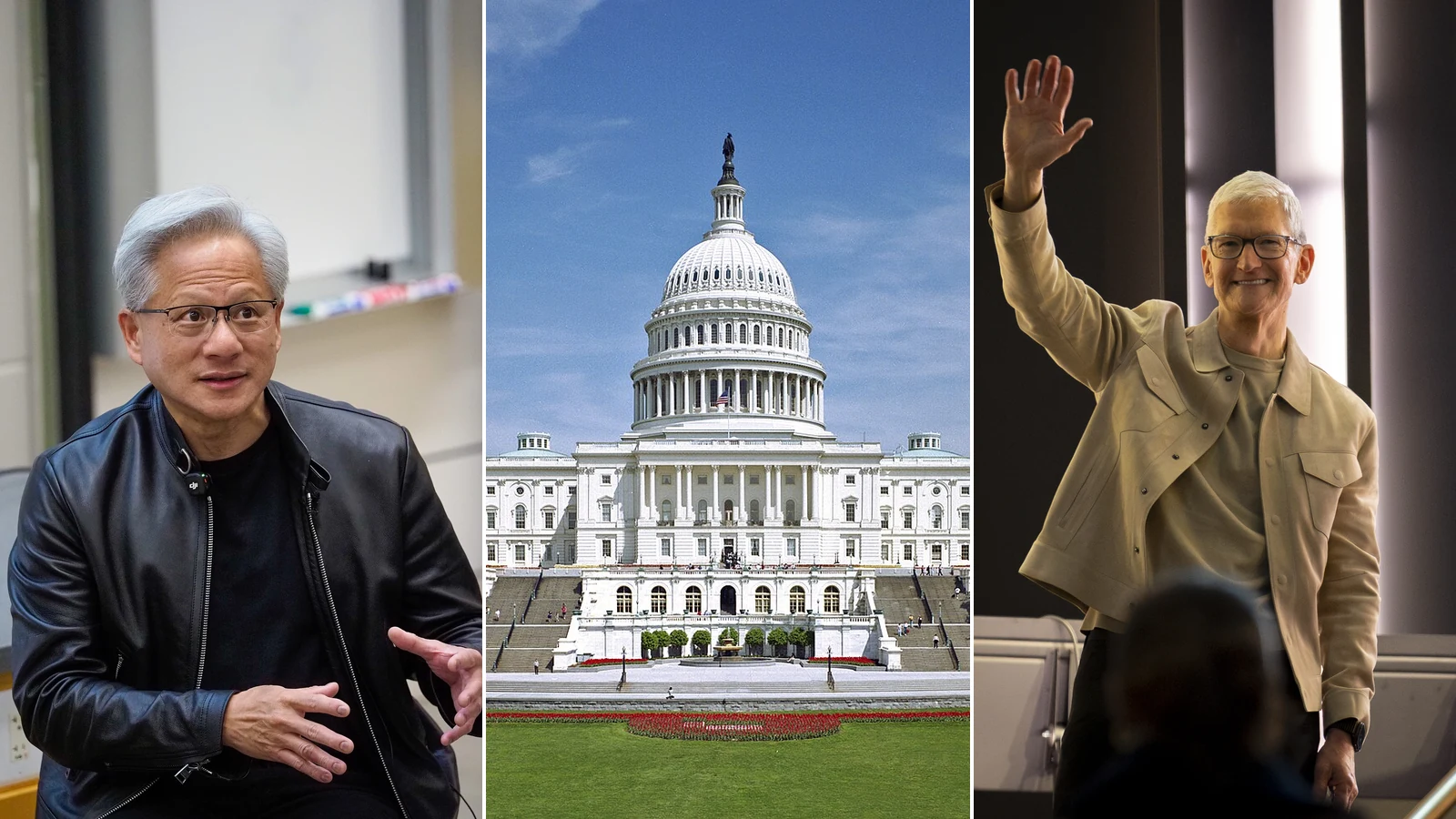
Former Nvidia CEO Jensen Huang agreed to testify before Congress ahead of Thanksgiving (Nov. 26), House Foreign Affairs Chairman Brian Mast announced Thursday, Nov. 12, 2026, hours after Huang resigned and President Donald Trump pitched Apple’s Tim Cook to replace him.
Key facts on Jensen Huang’s Congressional testimony and CEO succession talk
- Testimony window: Huang’s legal team notified lawmakers Wednesday night that he will appear before Thanksgiving—potentially as soon as next week—in a joint closed-door session expected to be conducted under oath, video-recorded, and transcribed.
- Three investigating House panels: The demand stems from a Nov. 4 letter signed by House Foreign Affairs Chair Brian Mast (
R-Fla.), House China Select Committee Chair John Moolenaar (R-Mich.), and House Intelligence Chair Rick Crawford (R-Ark.). - Subpoena warning: Both Mast and Moolenaar confirmed Thursday that Huang’s resignation from Nvidia does not shield him from oversight and that lawmakers will issue an immediate subpoena if scheduling talks stall.
- Senate document-preservation push: Democratic Sens. Elizabeth Warren (
D-Mass.) and Chris Coons (D-Del.) formally urged the Trump administration on Thursday to preserve all federal records tied to Nvidia’s AI chip exports to China. - Trump’s CEO pick: On Truth Social Thursday morning, President Trump backed Apple executive chairman and former CEO Tim Cook to take over Nvidia, writing:
"A Legend replaces a Legend!"
Why is Congress requiring Jensen Huang to testify after resigning from Nvidia?
Bipartisan scrutiny on Capitol Hill intensified rapidly this week after Huang resigned immediately as Nvidia’s president, CEO, and board director following 33 years atop the world’s most valuable chipmaker. Lawmakers across three national-security committees are examining whether Huang’s admitted past personal relationship with former Singapore-based Megaspeed executive Alice Huang—whom U.S. intelligence officials suspect of acting as a People’s Republic of China intelligence asset—exposed Nvidia’s supply chain or influenced lobbying over U.S. export controls.
In their Nov. 4 letter, Mast, Moolenaar, and Crawford gave Huang until the end of the day Wednesday, Nov. 11, to commit to a joint briefing covering Nvidia’s internal counter-espionage safeguards and third-party data-center shipments through Singapore and Malaysia.
“We heard back from their team last night,” Mast told reporters on Capitol Hill Thursday morning. “We want to see him basically in a week—sooner rather than later. If negotiations shut off and we don’t think they’re in good faith, okay, fine, do that—I’ll just subpoena you for the next day.”
Mast added that while he and Huang have clashed repeatedly over tighter semiconductor export restrictions to China, “Nvidia is a very important company to the United States of America. I don’t want to see anything hurt in Nvidia, but he has some very serious questions to answer.”
What are Democrats demanding on Nvidia’s China AI chip export records?
Thursday’s oversight push quickly crossed party lines alongside ongoing FBI counterintelligence inquiries and federal shareholder litigation. House Foreign Affairs Ranking Member Gregory Meeks (D-N.Y.) told reporters there was “no question” Democrats supported investigating the potential national-security fallout.
In the Senate, Warren and Coons called on executive-branch agencies to lock down licensing communications and export-control records involving Nvidia’s China-facing accelerators. “Jensen Huang’s decision to resign from NVIDIA does not absolve him, other executives, or the company as a whole of responsibility for putting our national security at risk or for any potential violations of our laws,” Warren wrote Thursday. “They still owe Congress answers.”
Huang has previously denied compromising national security or proprietary Nvidia technology, while Megaspeed stated this week that it cooperated fully with U.S. inspections.
Why did President Trump pitch Apple’s Tim Cook to become Nvidia’s next CEO?
While Capitol Hill focused on subpoenas and export logs, President Trump steered the succession debate toward Silicon Valley’s most prominent corporate statesman—avoiding mention of the workplace scandal that also included New York Times reporting on a second relationship between Huang and senior Nvidia executive Kimberly Powell.
“NOW THAT Nvidia CEO JENSEN HUANG, who has done a fantastic job, has resigned, there is only one man to take his place – TIM COOK of Apple. A Legend replaces a Legend!” Trump posted on Truth Social Thursday morning.
Cook, who stepped down after more than a decade as Apple’s chief executive in September 2026 and now serves as executive chairman of Apple’s board of directors, had already been floated a day earlier in a Time column by Yale School of Management leadership scholar Jeffrey Sonnenfeld, who pointed to Cook’s unmatched track record succeeding iconic Apple co-founder Steve Jobs.
Inside Santa Clara, however, newly appointed Chair of the Board Harvey C. Jones signaled steady continuity behind interim CEO and 13-year finance chief Colette Kress while Nvidia’s board conducts an internal and external permanent search. After plunging sharply in premarket trading on Thursday’s announcement, Nvidia shares (NVDA) pared roughly half of their early losses during regular midday Wall Street trading as institutional buyers stepped back in ahead of Tuesday’s Nov. 17 earnings report.